
When planning an eLearning course, should everyone follow the same route, or should their decisions change what happens next? This is the central question behind branching scenarios vs linear courses. Your answer shapes how you deliver content, provide practice, and assess learning.
Neither structure is automatically better. Linear instruction suits a defined process, while branching can support decisions in changing situations. Learning objectives, learner needs, development resources, and maintenance requirements should guide the choice. Sometimes, a hybrid approach offers the best balance.
ActivePresenter is an eLearning authoring tool that supports both structured linear courses and branching learning experiences. Understanding the differences helps you choose before development begins.

What is a Linear eLearning Courses?
A linear eLearning course takes learners through a largely predetermined sequence of content and activities. They may control their pace, revisit lessons, or answer questions, but the core learning path remains the same.
A typical structure is:
Introduction → Explanation → Demonstration → Practice → Assessment
For example, a course on submitting an employee expense claim might explain the policy, demonstrate the submission process, and check whether learners understand the required steps. The sequence is useful because each step builds on what came before it.
Importantly, linear does not mean passive. Videos, interactive questions, simulations, and feedback can all fit within a linear structure. What makes it linear is the overall progression, not the absence of interaction.
What is a Branching Scenario in eLearning?
A branching scenario presents a situation and lets learners make choices that influence the path, feedback, or outcome they encounter. Instead of only checking whether someone remembers information, it can show what happens when they apply that information in context.
A typical structure is:
Situation → Decision → Consequence → Feedback or Another Decision
Imagine a customer service course in which a learner must respond to an unhappy customer. A response that acknowledges the customer’s frustration might lead to a constructive conversation, while a dismissive response might make the situation harder to resolve. Each route gives the learner a reason to reflect on the choice.
Branches do not have to continue separately until the end. They can reconnect after different consequences or feedback. The important feature is that the learner’s choice makes a meaningful difference.
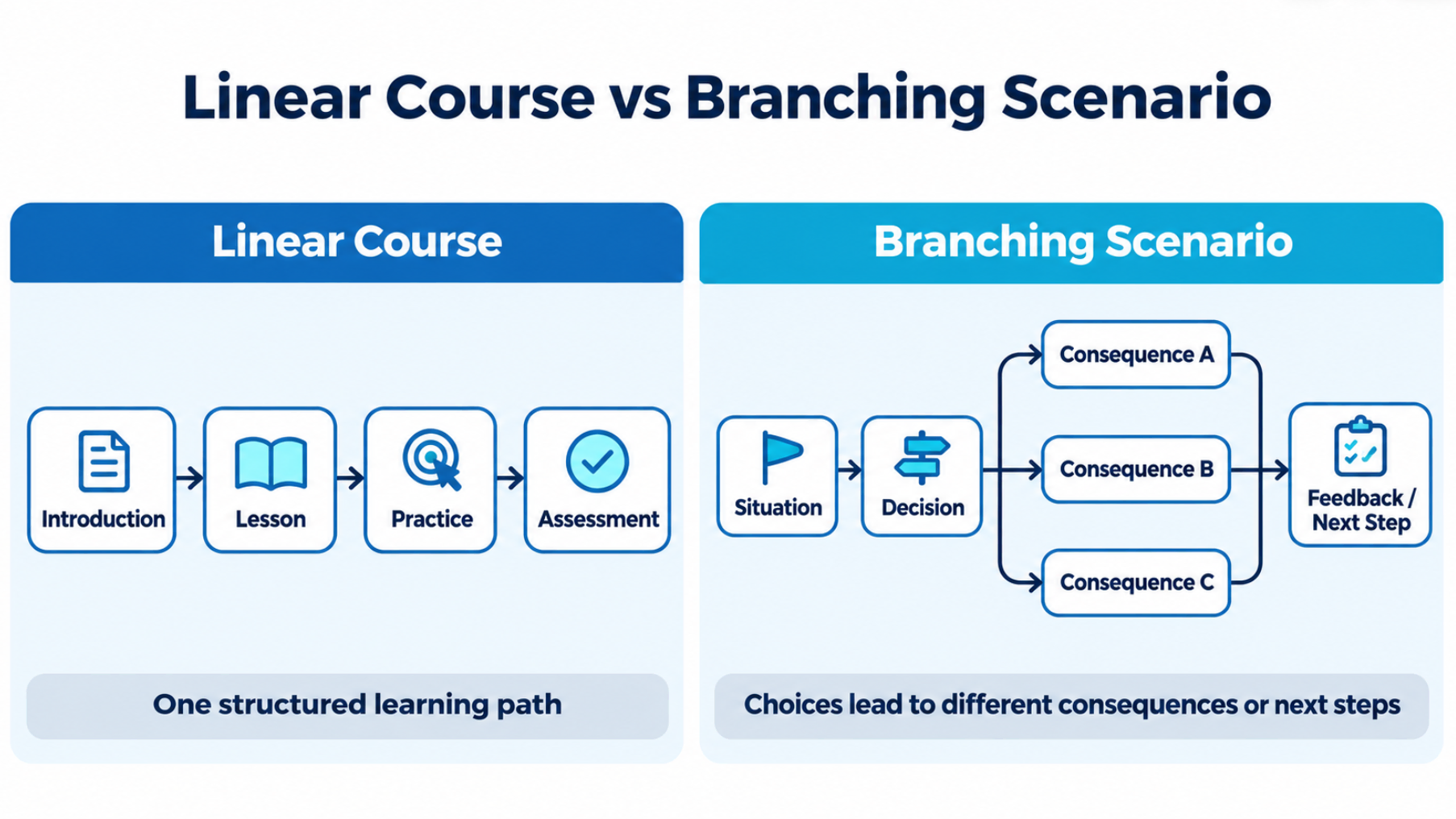
Branching Scenarios vs Linear Courses: Key Differences
Choosing a course structure involves both the learning experience and the work required to produce it. The comparison below highlights the practical trade-offs.
| Factor | Linear Course | Branching Scenario |
| Learning path | Mostly predetermined sequence | Changes based on learner decisions |
| Learning objective | Knowledge acquisition, concepts, procedures | Judgment, problem-solving, application |
| Learner control | Mainly pacing and navigation | Decisions influence learning paths and outcomes |
| Development effort | Usually lower | Usually higher because of multiple routes |
| Maintenance | Generally easier to update | Updates may affect connected branches |
| Testing | Check a largely fixed learning sequence | Check alternative paths, decisions, feedback, and outcomes |
| Suitable use cases | Onboarding, policy training, product knowledge | Customer service, leadership, ethical dilemmas, decision-making |
Neither format is inherently superior. Branching adds value when choices provide useful practice and feedback; when everyone needs the same explanation, extra routes may distract. Select the instructional fit first, then assess whether the scope is realistic.
When is a Linear Course the Better Choice?
Choose a linear course when learners need essential information in a reliable order: foundational knowledge, policy updates, product introductions, or standardized procedures.
For an expense-claim course, employees must learn what qualifies for reimbursement, which documents to provide, and how to submit a request. An ordered lesson, demonstration, and short knowledge check address those needs directly. Alternative storylines would add little.
Linear delivery also suits onboarding or mandatory training when everyone must receive consistent information. It still allows questions and guided practice without changing the course route.
Ask: Would different learning paths actually help people meet this objective? If not, a well-designed linear course is often the clearer option.
When are Branching Scenarios Worth the Extra Effort?
Branching is worthwhile when success depends on choosing what to do, not simply knowing the answer. Learners may need to evaluate alternatives, respond to people, solve problems, or consider how one action affects the next.
In a leadership course, a manager addressing poor performance might begin with an accusation, ask an open question, or postpone the conversation. Each choice could affect the employee’s reaction. Feedback helps learners understand why one approach supported the conversation while another made it harder.
Here, scenario-based learning serves a specific skill: judgment in context. Strong branches reflect realistic choices, credible consequences, and feedback learners can apply later.
When Branching Maybe Not Worth It
Not every choice deserves a separate route. If options lead to essentially the same explanation or have no meaningful consequence, branching adds little.
A wrong answer followed by generic “try again” feedback is not necessarily a branching scenario; it may simply be a knowledge check. If a guided example or practice question meets the objective, an elaborate scenario is unnecessary. Keep decision points that teach something and simplify the rest.
When Does a Hybrid eLearning Approach Work Best?
Some learners need a clear explanation before they are ready to make informed decisions. This is where hybrid eLearning design is useful: provide a common foundation, then introduce branching where learners need to apply it.
Example of a Hybrid Learning Path
Linear Instruction → Guided Example → Branching Practice → Summary/Debrief
In a customer service course, learners could first study principles for responding to complaints. A guided example could show those principles in action. Next, a short branching exercise could let learners choose responses to a customer, observe the results, and consider alternative approaches. A final debrief could explain the reasoning behind effective choices.
This arrangement avoids asking beginners to make decisions before they have enough context. It also avoids branching every lesson. The course stays structured where consistent instruction matters and becomes decision-based where practice matters
How to Choose the Right eLearning Course Structure
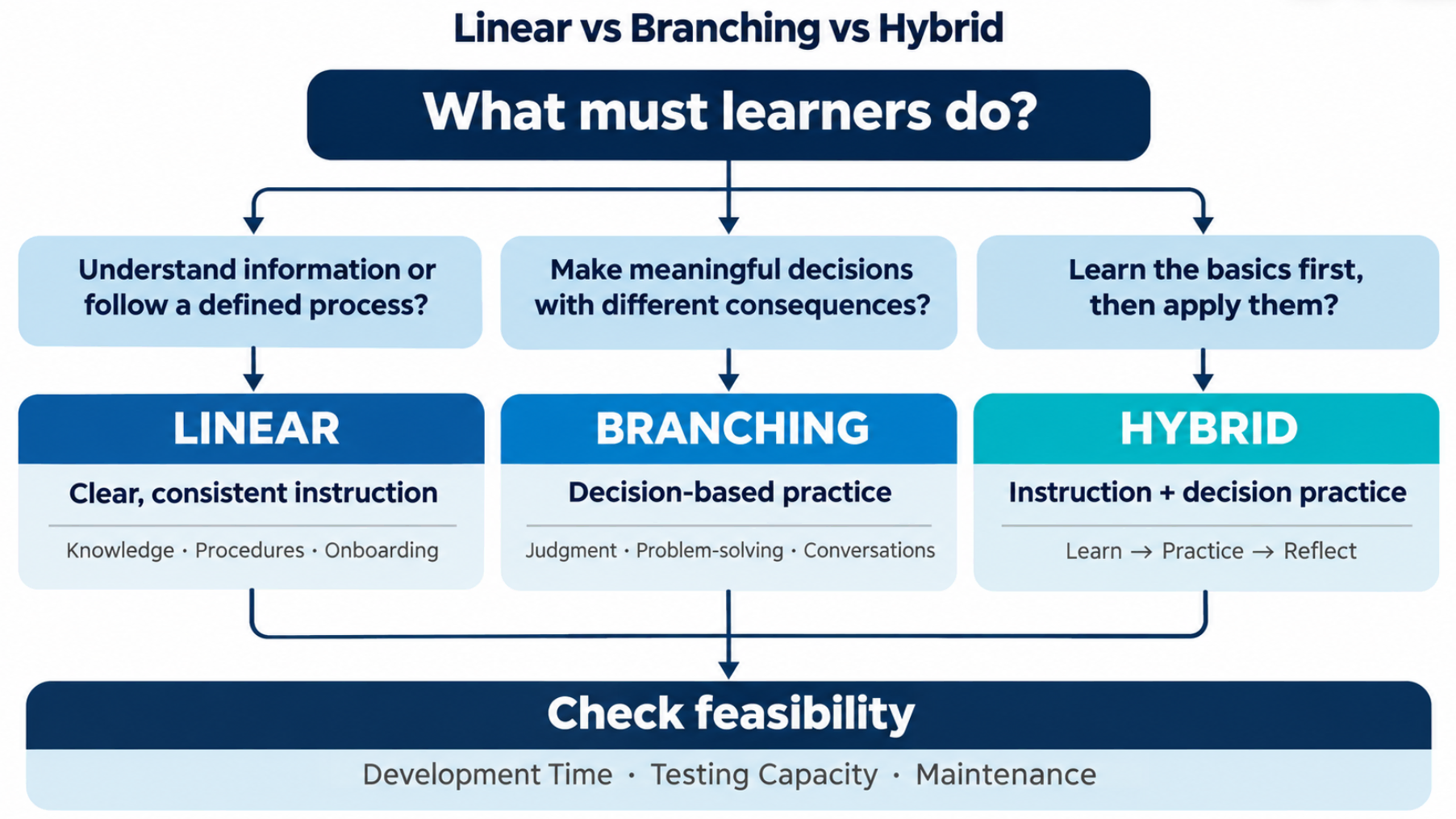
Write the learning objective as something learners must do. “Understand complaints” is broad; “choose an appropriate response to a frustrated customer” points toward decision practice. Then assess your eLearning course structure using these questions.
A Practical Decision Checklist
- Is the goal to explain information or a defined process? Linear may be enough.
- Must learners choose between plausible actions with different consequences? Consider branching.
- Do learners need foundational knowledge before making decisions? Consider hybrid.
- Can the team develop, test, and maintain multiple routes? If not, narrow the branching scope.
- Would one targeted scenario achieve the objective? If so, include it in an otherwise linear course.
These are prompts, not a scorecard. Weigh the learning objective alongside audience readiness and production constraints.
| Choose | When |
| Linear | The primary goal is consistent knowledge delivery or following a standard procedure. |
| Branching | Meaningful decisions and their consequences are central to the learning objective. |
| Hybrid | Learners need structured instruction before decision-based practice. |
If you are still choosing a platform for course development, compare eLearning authoring tools based on the level of interactivity, testing, and maintenance your project requires.
Designing and Reviewing Learning Paths with ActivePresenter
Once you have chosen the right course structure, ActivePresenter gives you the tools to organize, build, and review the learning experience.
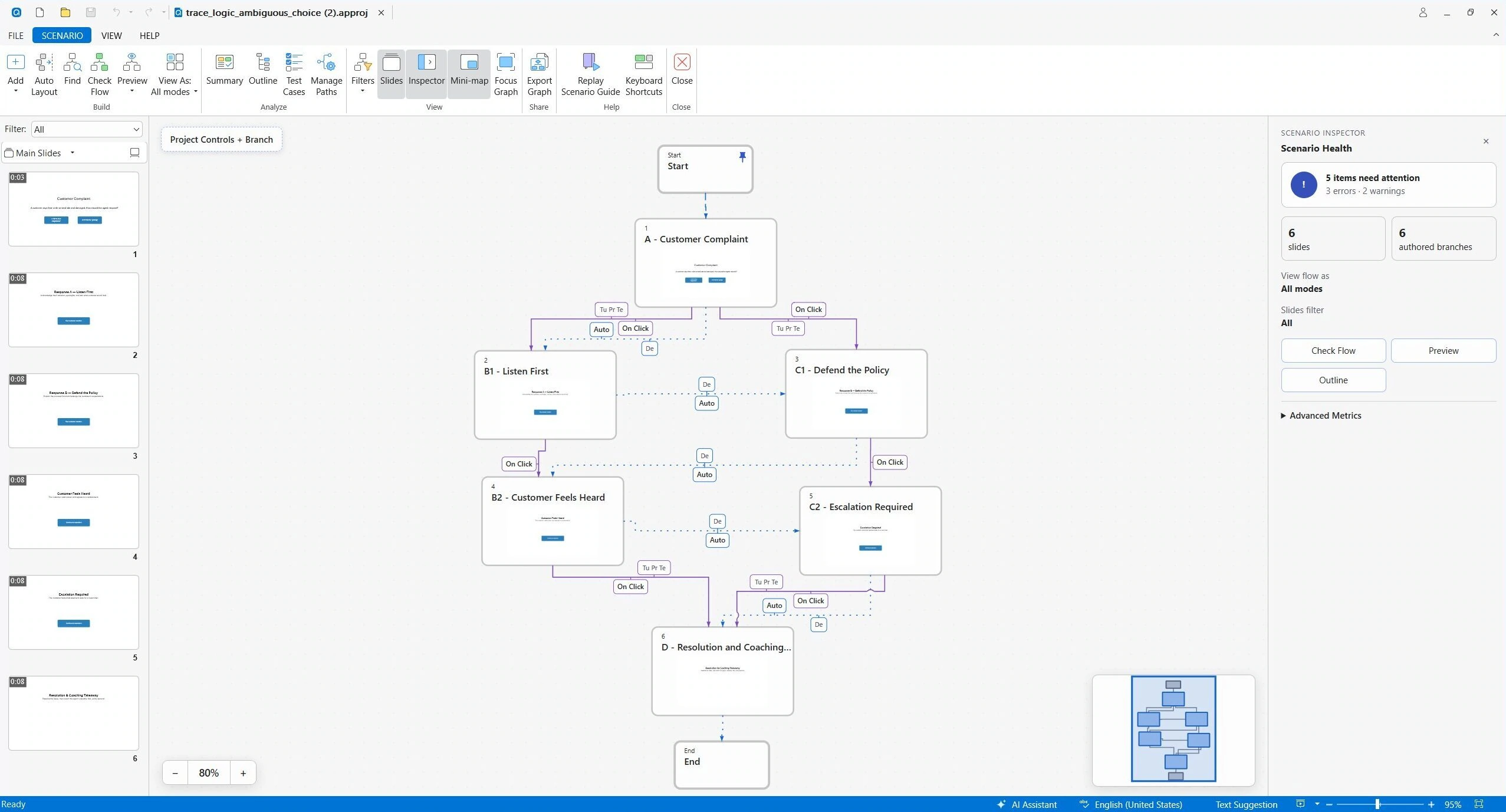
For a linear course, authors can organize slides in a structured sequence. For branching learning, they also need to see where each decision may take learners.
In ActivePresenter 10.6, Scenario Editor displays project navigation as a graph. Slides appear as nodes, while connections represent navigation. Authors can create and review branches and inspect how different routes connect.
Check Flow helps flag unreachable slides, dead ends, and invalid navigation targets; Simulate lets authors explore possible learner routes. These features help review the structure, though the author still decides whether each branch serves a learning objective.
For implementation details, see the guide to creating branching scenarios in ActivePresenter 10.6.
Final Thoughts
The simplest structure that meets the learning objective is usually the better choice: linear for clarity and consistency, branching when decisions and consequences are part of the skill, and hybrid when instruction must come before application.
ActivePresenter supports structured courses and decision-based branching in one authoring environment, letting the learning need—not the format’s complexity—guide the design.